
Hersey ties rest to liberation in 2026 MLK Commemorative Lecture
By Laura Gallup
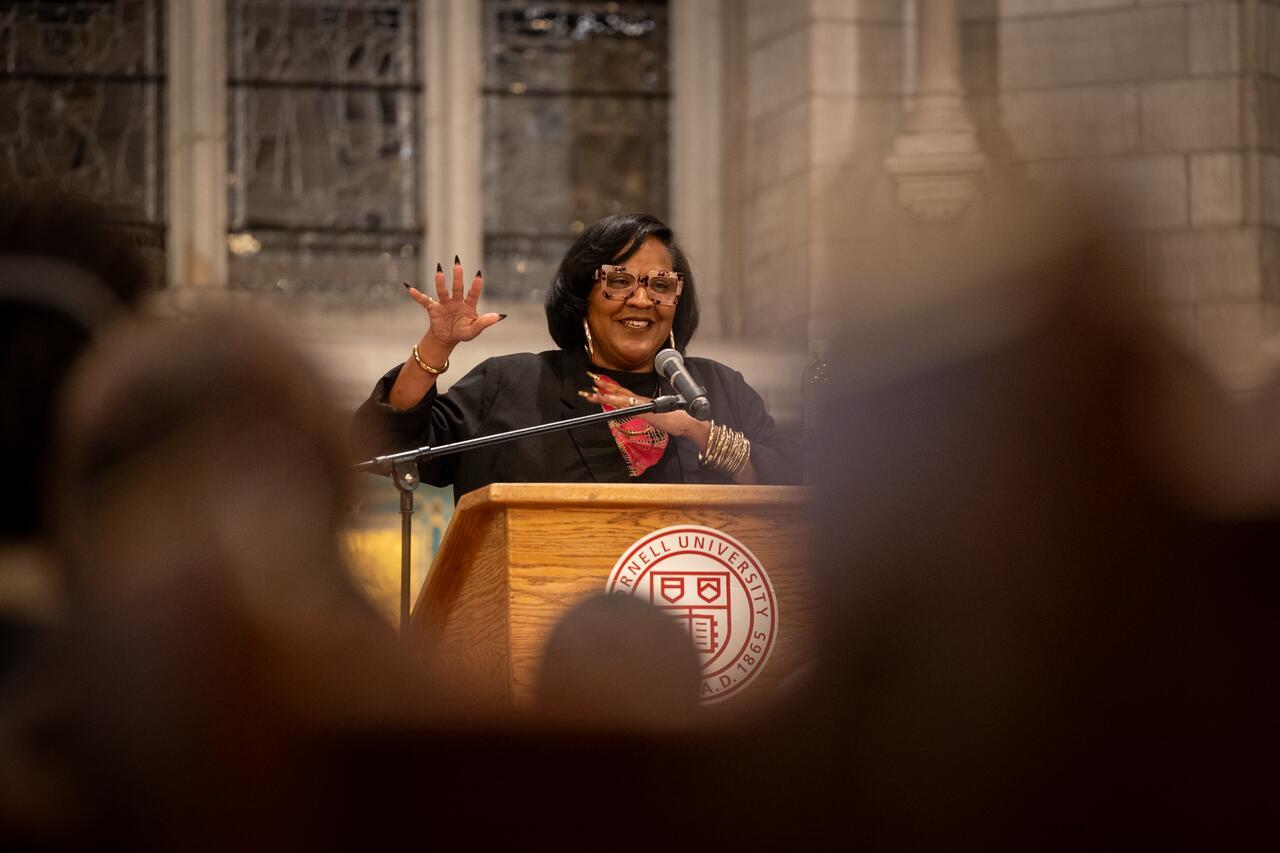
Tricia Hersey urged Cornell students and community members to reconsider their relationship to work, exhaustion and productivity during the 2026 Martin Luther King Jr. Commemorative Lecture in Sage Chapel on Feb. 9.
“Capitalism wants us to be a machine, but we are not machines,” said Hersey, founder of The Nap Ministry. “The systems want us exhausted. We’re easier to manipulate.”
Titled Rest is Resistance: A Conversation with Tricia Hersey, the lecture drew 250 in-person attendees and more than 430 virtual registrants from Cornell and the surrounding community. Hersey — a multidisciplinary artist, theologian and author of the New York Times bestselling book Rest Is Resistance: A Manifesto — framed rest as both a human right and a radical act of resistance that disrupts grind culture.
Hersey founded The Nap Ministry in 2016 after experiencing burnout as a graduate student. What began as brief solo naps on library couches evolved into small public rest gatherings and eventually into a global movement that now hosts large-scale rest events, workshops and digital programming.
“Rest saved my life,” she said. “My pilgrimage with rest as a form of resistance and liberation is a deeply personal one. Resting was simply an attempt to solve a problem in my life.”
Hersey, the daughter of a Chicago union organizer and abolitionist pastor, grounded her message in theology and social justice and cited Martin Luther King Jr. as a key inspiration in her life.
“I am so grateful for the wisdom of Dr. Martin Luther King Jr., who proclaimed all political work is spiritual work,” she said, linking her framework of “Rest Is Resistance” to broader movements for racial and economic justice.
Rather than offering strategies to increase productivity, Hersey invited the audience to slow down in order to create space for clarity and discernment. She described her grandmother as an early influence; regardless of what was happening at home, she would sit quietly with her eyes closed for 30 to 60 minutes each day. When asked if she was sleeping, she would reply, “Every shut eye ain’t asleep. I am resting my eyes. I am listening,” Hersey recalled.
A portion of the lecture — which Hersey referred to as a “sermonette” — focused on gratitude. She read a long list of things she is grateful for while encouraging the audience to cultivate thankfulness as a daily practice.
“It shifts the brain to a more resilient state,” she said of practicing gratitude as another way to resist a system that constantly tells us we are not enough. “Making it so much easier to focus on the good things in life, to manage very difficult emotions. And we need to manage our emotions in a time like this.”
During a moderated discussion following the lecture, Hersey framed exhaustion as a systemic condition rather than a personal failing. She encouraged students to question a culture - including an academic one - that glorifies sleeplessness and burnout, and to find a community to rest with.
“We won’t heal alone,” she said.
The lecture was one of five events Hersey participated in as part of Cornell’s annual Martin Luther King Jr. Commemoration, a cross-campus and community initiative honoring King’s life and legacy. In addition to the keynote, Hersey met with local community leaders at a luncheon hosted by the Greater Ithaca Activities Center and led three “Rest Sessions” for the Cornell community, where participants laid down for guided meditation led by Hersey.
The event was sponsored by Office of Spirituality and Meaning-Making; Black Student Empowerment; Greater Ithaca Activity Center; Cornell Human Resources Department of Inclusion and Belonging; Office of Diversity and Inclusion at the College of Architecture, Art, and Planning; Health Promoting Campus; and Frederic C. Wood Lecture Fund.
Laura Gallup is a communications lead for Student and Campus Life.