
Accessibility at the Challenge Course
We customize every challenge course program to meet the skills, abilities and objectives of the groups that we are working with. When you request a program with CTLC, you'll be able to share any relevant information about your participants and then collaborate with a lead facilitator to make sure we design the best program for your team. We have a variety of facilities that offer different types of accessibility, so please review the Essential Eligibility Criteria (EEC) (link coming soon) to get a better understanding of what is required to participate in our programs and how we can accommodate individuals with different abilities.
If you believe you or your student may experience difficulty meeting any of these criteria, we encourage you to contact us. We are happy to explore supportive solutions or recommend an alternative course or program that may be better aligned with their abilities and needs.
Outdoor Challenge Course Programs
Meet all of the General EEC (link coming soon)
- Follow safety instructions in an unfamiliar or uncomfortable setting; working independently or with others to negotiate problem solving initiatives.
Challenge Course Programs (Low Ropes)
Ability to maneuver over uneven dirt trails with roots and rocks (a typical low element program may include a ½ mile of travel on trails)
- Adaptive equipment used to support balance and mobility approved by COE is allowed.
Challenge Course Programs (High Ropes)
Must meet all above Challenge Course EECs in addition to...
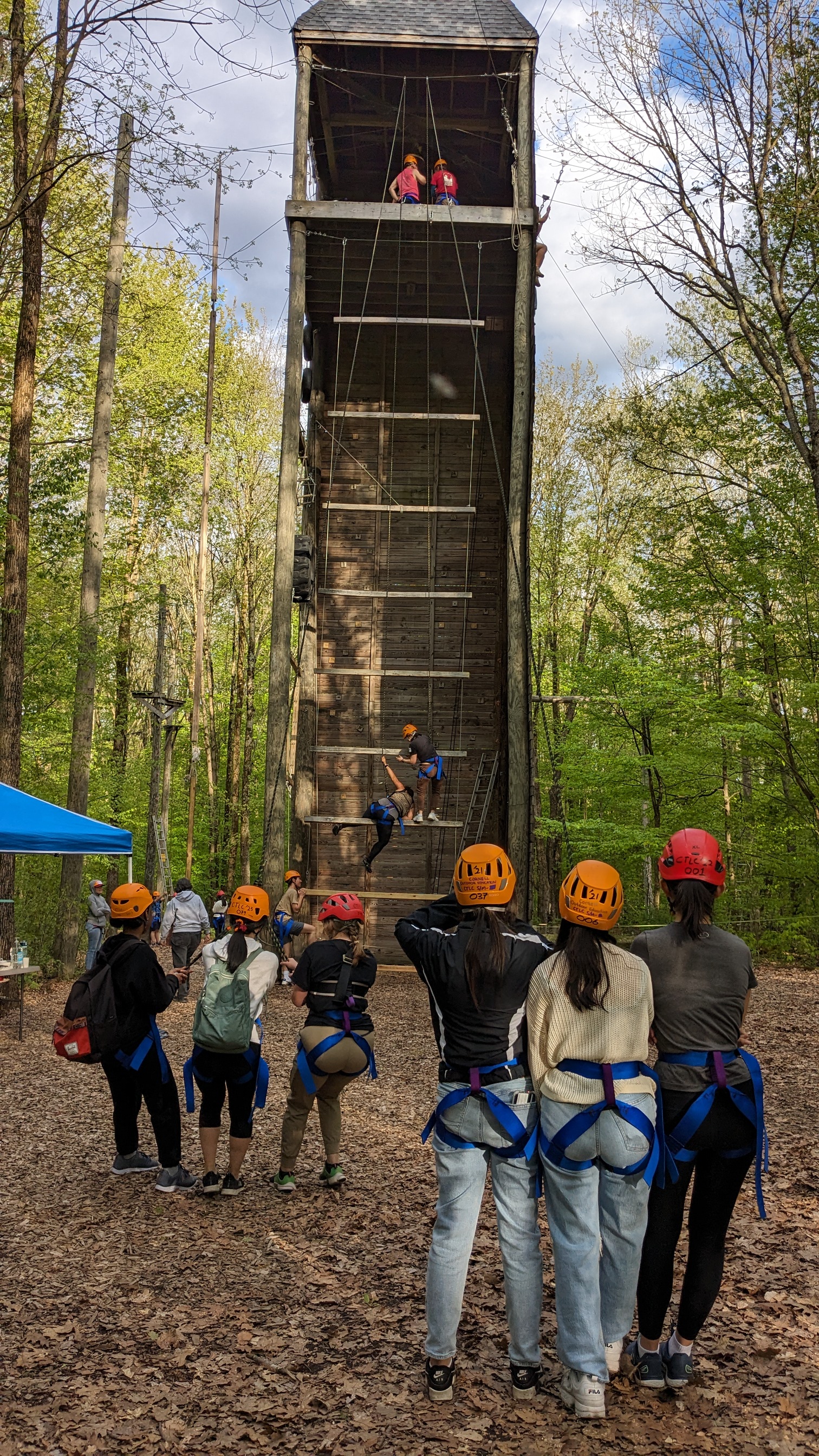
Wear all required protective equipment, including a climbing harness (standard waist and legs, seat, or full body) and climbing helmet. Use of adaptive equipment approved by COE is allowed.
Participants should be comfortable with participating in activities at heights from 10 feet to 50 feet
Ability to climb a 10 foot ladder and 20 foot vertical pole with hand and foot holds. Use of adaptive equipment approved by COE is allowed.
Participants must meet the following weight requirements for zipline, auto-belay, and quick jump events
The maximum weight for the course is: 300lbs.
The maximum weight for the Zip Line is: 250 Lbs
Balance and climb over stationary and moving structures
Indoor Challenge Course Activities
Meet all of the General EEC (link coming soon)

Follow safety instructions in an unfamiliar or uncomfortable setting; working independently or with others to negotiate problem solving initiatives.
Portable Teambuilding Programs
Meet all of the General EEC (link coming soon)
Indoor Challenge Course
This is an indoor, accessible challenge course with group based element and elevator access to the basement level gym where the course is located.

Participants should be comfortable with participating in activities at heights from 5 feet to 30 feet.
Wear all required protective equipment, including a climbing harness (standard waist and legs, seat, or full body) and climbing helmet. Use of adaptive equipment approved by COE is allowed.
The maximum weight for the course is: 300lbs.
A note about EECs: These criteria are not intended to be exclusionary, but rather to clearly identify the fundamental requirements for participation. They are directly related to safety and risk management considerations, as well as to achieving the educational objectives of the program. If a participant does not meet one or more of the EEC, we will assess whether reasonable accommodations can be made without compromising the health, safety, and positive learning environment of participants and staff, or altering the fundamental nature of the program.